The Real Reason Your Front Desk Still Misses Calls
Missed calls aren't a training problem. The real reason your front desk still misses calls is structural, and the fix doesn't require another hire.
Share:
Table of contents
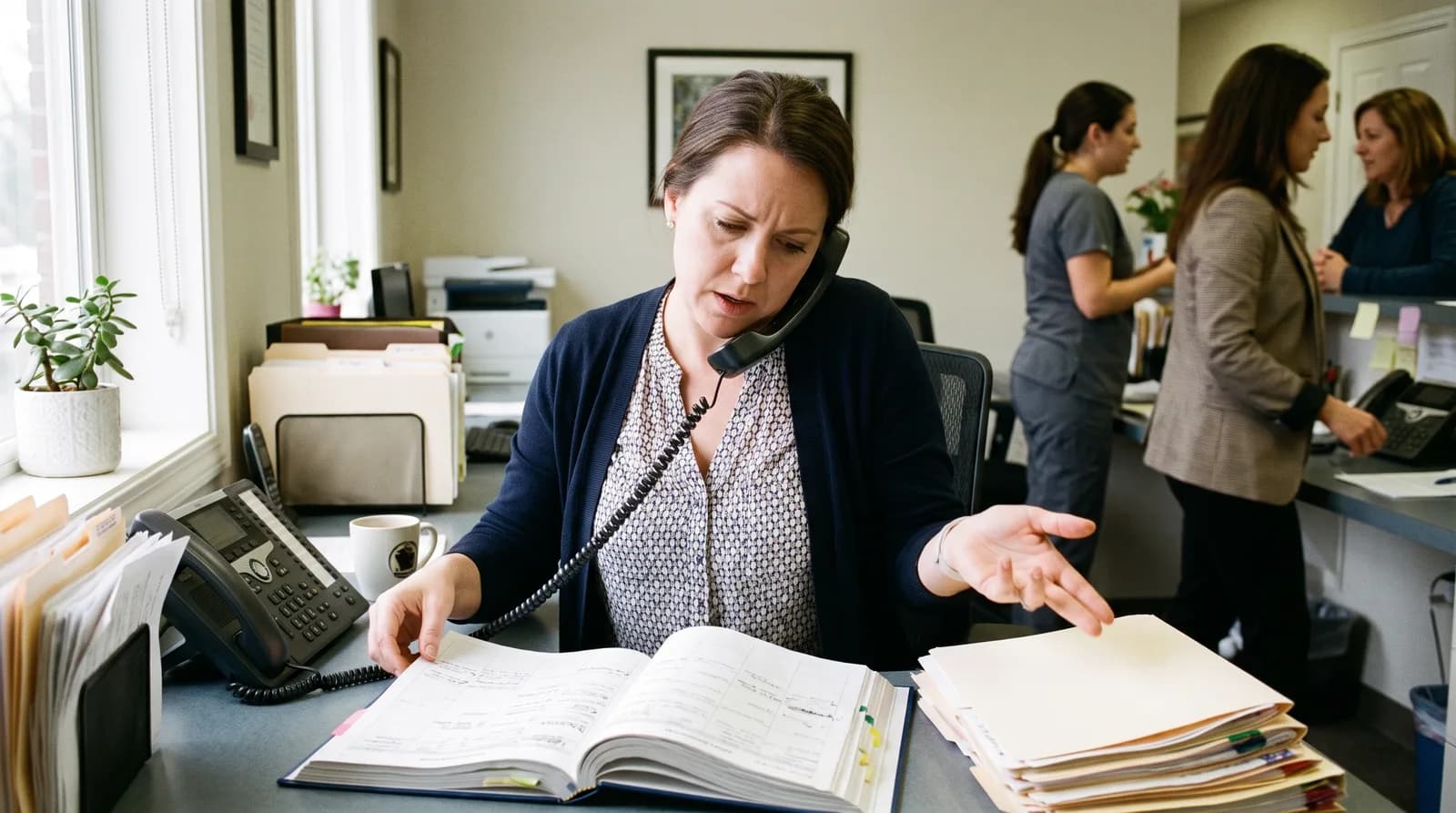
Your front desk still misses calls not because anyone is careless, but because a single person or small team can only handle one conversation at a time, no matter how skilled they are.
This piece looks at exactly where those missed calls come from and what actually fixes the gap. If your practice works with DentalBase's practice growth services, this specific gap is often the first thing a call audit reveals.
This guide covers why missed calls keep happening even with a capable team, and how DentiVoice closes that specific gap.
Why do missed calls keep happening even with a good team?
A front desk handling check-in, checkout, insurance questions, and the phone all at once will always lose some calls during the busiest stretches, since a person physically cannot be in two places simultaneously.
- Simultaneous patient interactions at the counter while the phone is ringing.
- Lunch coverage gaps when staffing naturally drops for a period.
- Multiple lines ringing at once during a genuinely busy morning.
ADA Health Policy Institute data shows 72% of patients rank convenience as a top factor, and a missed call is the clearest possible failure of that convenience, regardless of how good the team is otherwise.
None of this reflects poorly on the team. It reflects the simple mathematical reality of one person handling more demands than time allows during a busy stretch.
Understanding this distinction changes how a practice approaches the fix, since the goal becomes adding capacity rather than expecting more from people already working at their limit.
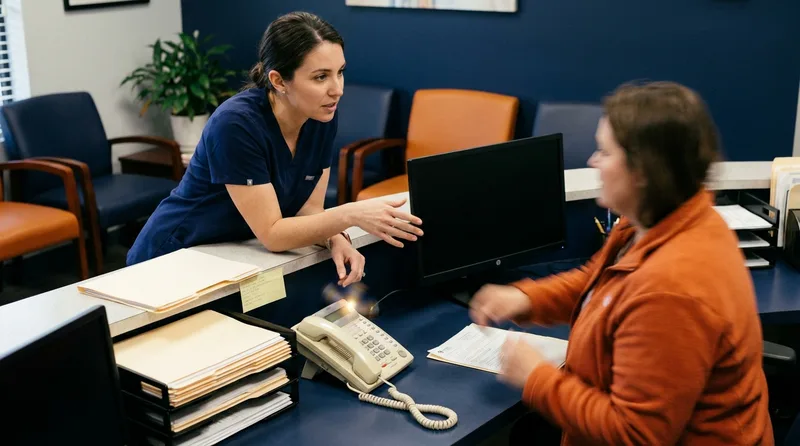
This reframing alone often changes the entire conversation from one about performance to one about resourcing, which tends to be far more productive for everyone involved.
Recognizing this distinction matters, since blaming the team for a structural limitation rarely leads to a real fix, only frustration on both sides. A structural gap needs a structural solution, not more pressure on the same people.
Where the missed-call gap shows up most
The numbers behind this pattern are consistent across practices of very different sizes, which is why the fix tends to look similar regardless of how a team is structured.
- 38% of new patient calls go unanswered during business hours, according to ADA Practice Transitions.
- 15 to 20 calls a week is the average volume a dental practice misses, according to Dental Economics.
- 27% of total call volume arrives after hours, according to Dental Economics, when the front desk is not staffed at all.
How much does each missed call actually cost a practice?
A single missed call can represent thousands of dollars in lifetime patient value once cleanings, treatments, and referrals over years are factored in, not just the value of one lost appointment.
This long-term view is easy to lose sight of in the moment, since a single missed call feels small when it happens, even though the cumulative effect rarely is.
Missed or miscounted calls alone can cost a practice over $1,200 in lifetime patient value per instance, according to ADA-cited estimates. That figure reframes a missed call as a real financial loss rather than a minor inconvenience.
BrightLocal's consumer research found that trust and responsiveness weigh heavily in how patients evaluate a business, and a missed call is one of the clearest ways that trust quietly erodes before a relationship even starts.
Multiply that figure across even a handful of missed calls per week, and the cumulative cost becomes significant enough to justify addressing directly rather than accepting as unavoidable.
A practice missing even three or four calls a week is looking at a meaningful annual cost once that figure compounds over fifty-two weeks.
Most practices underestimate this cost simply because a missed call leaves no obvious trace, unlike a visible mistake elsewhere in the practice.
Making this cost visible, even through a rough estimate, is often the first step toward treating it as a priority worth actually fixing.
A broken appointment or a billing error gets noticed and fixed quickly, while a missed call simply disappears into silence with no one the wiser.
This invisibility is exactly why measuring the actual volume matters, since intuition alone tends to significantly underestimate how often this is really happening.
What happens the moment a call goes unanswered
The behavior after a missed call is just as telling as the missed call itself, and it explains why the cost compounds so quickly.
80%
of callers who reach voicemail hang up without leaving a message, according to Forbes, and most never call back at all.
- 90 seconds is the average hold time before a patient hangs up, according to Marchex.
- Most patients call another practice the moment a call goes unanswered, according to Weave Communications.
None of that has to be permanent. This walkthrough of how AI reception reduces missed calls and voicemails shows what a front desk's answer rate looks like once the phone stops competing with everything else happening at the counter.
Want to know how many calls your practice is missing?
Book a demo to see a missed-call audit tailored to your practice's actual call patterns.
Book a Free Demo →Is hiring more front desk staff the right fix for missed calls?
Not always, since adding staff increases payroll costs year-round to solve a problem that may only spike during specific hours. Lunch or the first hour after opening are common examples.
HubSpot's marketing benchmark data consistently shows that fixed costs scaled to peak demand often waste resources during quieter periods. Additional front desk staff follows that same pattern closely.
A more targeted fix addresses the specific hours or situations where calls actually go missed. It avoids adding a full-time cost to cover a problem that is really only occasional.
Most practices find their missed calls cluster around a handful of predictable windows, which makes a targeted fix both more effective and more affordable than blanket staffing.
Before adding headcount, it is also worth checking whether cross-training the front desk staff you already have closes the same gap, since coverage during those specific windows is often a scheduling fix rather than a hiring one.
Identifying those specific windows in advance is usually straightforward once someone actually sits down to review call logs for a representative week.
This is exactly the kind of targeted coverage DentiVoice is built to provide, picking up specifically where a human team reaches its natural capacity.
This targeted approach costs less than full-time staffing while still closing the actual gap, since it activates only when the team is genuinely at capacity.
Blanket staffing vs. targeted coverage
Laid side by side, the cost pattern of each option makes the mismatch clear.
| Approach | Cost pattern | Coverage gap addressed |
|---|---|---|
| Additional front desk hire | Fixed cost, year-round | Covers all hours evenly, including slow ones |
| Targeted AI coverage (DentiVoice) | Activates only during overflow or after hours | Matches coverage to the actual missed-call windows |

The economics here favor a targeted fix over blanket staffing in almost every practice scenario, once the actual numbers are compared side by side.
Practices that run this comparison directly tend to find the targeted option wins clearly, especially once the full cost of a new hire is accounted for.
Your front desk still misses calls in these predictable windows precisely because no reasonable staffing level fully eliminates them without significant added cost.
How does DentiVoice actually close this specific coverage gap?
DentiVoice answers the moment a call would otherwise go to voicemail. This applies whether every line is busy, the team is with a patient, or the call comes in outside business hours entirely. This is the specific mechanism that finally closes the gap a good team alone cannot.
Google's own guidance on user experience emphasizes closing gaps at the exact point of friction. That principle applies directly to catching a call at the precise moment it would otherwise be missed.
The front desk continues handling in-person patients without interruption, while DentiVoice handles the caller who would otherwise simply hear ringing until they gave up.
This coverage does not replace the team; it fills the specific gap that exists no matter how well-staffed or well-trained that team already is.
That coverage only feels seamless, though, when the AI is trained to speak and triage the way that team already does. Our guide to customized dental voice AI and practice philosophy covers how that training actually gets built.
Even an excellent, experienced front desk still runs into the same physical limitation of only being able to handle one conversation at a time.
No amount of training changes this basic constraint, which is exactly why the fix needs to address capacity rather than skill.
This is worth stating plainly, since it reframes the whole problem away from staff performance and toward a simple question of available coverage.
What DentiVoice picks up automatically
The coverage applies consistently across every scenario where a human team physically cannot answer.
- Every line busy during a genuinely packed morning or afternoon.
- Lunch and shift-change windows when staffing naturally thins out.
- Evenings, weekends, and holiday closures when no one is on-site at all.
- A team already mid-conversation with a patient at the counter.
Does this change what the front desk actually does day to day?
Yes, the team spends less time apologizing for missed calls or scrambling to catch up on voicemails. They spend more time focused on the patients physically in front of them.
Moz's guide to user experience covers how removing friction from a workflow improves outcomes broadly. Eliminating the constant tension between phone and counter is exactly that kind of friction removal.
Staff often describe feeling less rushed once the pressure of racing to answer every single ring is no longer part of the job.
This shift in daily experience is one of the most immediate changes practices notice, even before the booking numbers fully reflect the difference.
A calmer front desk also tends to interact more warmly with patients in the office, since they are no longer splitting attention between two demands at once.
That warmth is often subtle, but patients notice it, even if they could not articulate exactly what changed about their visit. That same warmth is one of the first-visit habits that bring patients back for a second visit, so a calmer front desk pays off well beyond the phone lines.
A front desk that feels less rushed also tends to retain staff longer, since chronic multitasking under pressure is a common source of burnout in this specific role.
A relaxed, attentive front desk often shows up in review language too, even when the review itself never mentions the phone at all.
Day-to-day changes practices report
Staff tend to describe the shift in fairly consistent terms once the pressure of catching every ring eases.
- Less apologizing to patients at the counter for a phone that will not stop ringing.
- Fewer voicemails to work through at the end of a shift.
- More attention on the patient physically in the chair or at the counter.
Want to close this gap without adding headcount?
See how DentiVoice picks up exactly where a human front desk reaches its limit.
See AI Receptionist →Before you read the data, check when your calls actually land. In markets where patients commute long distances, the missed-call peak sits at 7 AM and 7 PM rather than midday, so a 9-to-5 fix leaves the real gap open. Our look at why Maryland practices miss commuter-hour calls maps that timing in detail.
What data should a practice track to confirm the gap is closing?
Track total missed calls before and after adoption, calls answered during identified peak periods, and bookings generated from calls that would have previously gone unanswered entirely without any coverage at all.
Answering more calls only helps if those extra bookings are also accurate. Once a previously missed call gets picked up, it still has to clear the same availability, type, and provider checks as any other booking.
Review this data over the first two or three months. That window typically reveals the full pattern of when and how often the gap was actually occurring throughout a typical week.
| Metric | What it reveals |
|---|---|
| Missed calls before vs. after | The direct size of the gap being closed |
| Calls answered during peak periods | Whether the specific bottleneck hours are covered |
| Bookings from previously missed calls | Whether the recovered calls convert into real patients |
Secondary signals worth tracking
A few supporting metrics round out the picture beyond the core three.
- Average hold time before a caller gives up, tracked before and after adoption.
- After-hours booking activity, since 27% of call volume arrives outside business hours, according to Dental Economics.
- Voicemail abandonment rate, given that 80% of callers who reach voicemail never leave one, according to Forbes.
Related: This exact coverage gap is one of the most common reasons practices first look at DentiVoice. See how DentiVoice answers every call →
How Do You Fix It When Your Front Desk Still Misses Calls?
Start by measuring current missed-call volume, specifically noting when it happens most. That pattern reveals whether the gap is a lunch-hour issue, an overnight issue, or both at once for your practice.
DentalBase can help configure DentiVoice around that specific pattern. The fix then targets the actual gap rather than applying a generic solution to a problem that looks different at every practice.
Most practices find this initial measurement step takes only a week or two, since the pattern of missed calls tends to repeat fairly consistently once tracked.
Once that baseline exists, configuring the actual coverage becomes a much more straightforward, targeted decision rather than a guess. This turns an ambiguous problem into a concrete, solvable one with a clear starting point. Most practices are surprised by how clear the pattern becomes once they actually look, since the gap usually feels far more mysterious before it is measured than after.
Your front desk still misses calls because no team, however capable, can be in two places at once. Closing that gap does not require more staff, just coverage for the specific moments a human team cannot fully cover.
Quick recap
- Simultaneous demands at the counter and phone cause most missed calls.
- Each missed call carries a real financial cost, often over $1,200 in lifetime value.
- Adding staff year-round to fix an occasional spike often wastes resources.
- DentiVoice answers the exact moment a call would otherwise go to voicemail.
- The front desk experience improves as the pressure to catch every call eases.
- Track missed calls before and after adoption to confirm the gap is closing.
Start by measuring exactly when calls go missed today, since that pattern is the clearest guide to the fix that will actually work.
Related: A fixed phone gap should show up on a dashboard, not just in fewer complaints. See where missed call rate ranks among the ten dental marketing metrics worth tracking →
See Exactly Where Your Calls Are Being Missed
Book a free demo to see a call pattern audit built for your specific practice.
Book a Free Demo →Related: The deeper issue is that qualified front desk staff are hard to hire and harder to keep. Read the dental front desk staffing crisis and how AI fills the gap.
Want to explore more DentiVoice features?
Browse Resources →Sources & References
Frequently Asked Questions
A front desk handling check-in, checkout, insurance questions, and the phone at once will always lose some calls during busy stretches, since a person cannot be in two places simultaneously no matter how skilled they are.
Missed or miscounted calls can cost a practice over $1,200 in lifetime patient value per instance, according to ADA-cited estimates, once cleanings, treatments, and referrals over years are factored in.
Not always, since adding staff increases payroll costs year-round to solve a problem that may only spike during specific hours like lunch, wasting resources during otherwise quieter periods of the day.
DentiVoice answers the moment a call would otherwise go to voicemail, whether every line is busy, the team is with a patient, or the call comes in outside business hours entirely.
Yes, the team spends less time apologizing for missed calls or catching up on voicemails, and more time focused on the patients physically in front of them at the practice.
Track total missed calls before and after adoption, calls answered during identified peak periods, and bookings generated from calls that would have previously gone unanswered entirely.
Was this article helpful?
Written by
DentalBase Team
Expert dental industry content from the DentalBase team. We provide insights on practice management, marketing, compliance, and growth strategies for dental professionals.